The Big Picture
Implementation of Te Puna Taio gives teachers a resource so they can start to experiment and try new things for the benefit of our kids and it will look different for each school and community, depending on their specific situation.
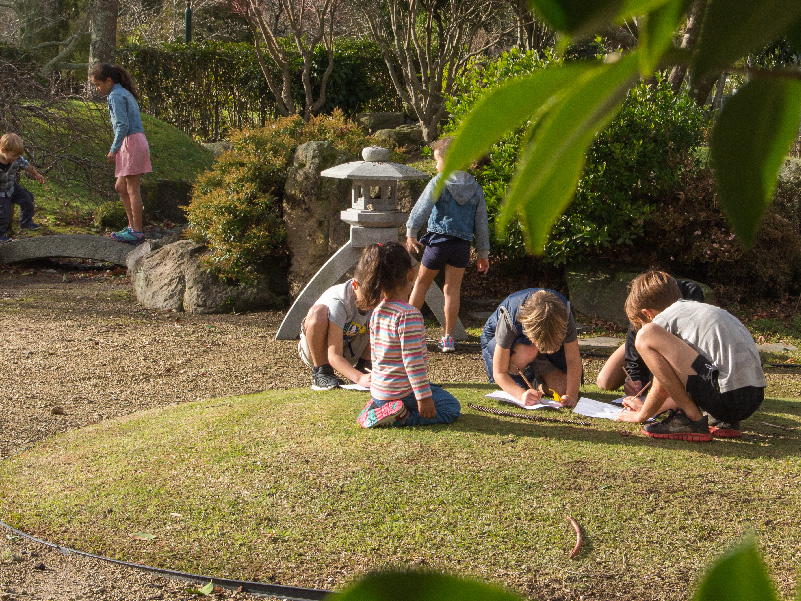
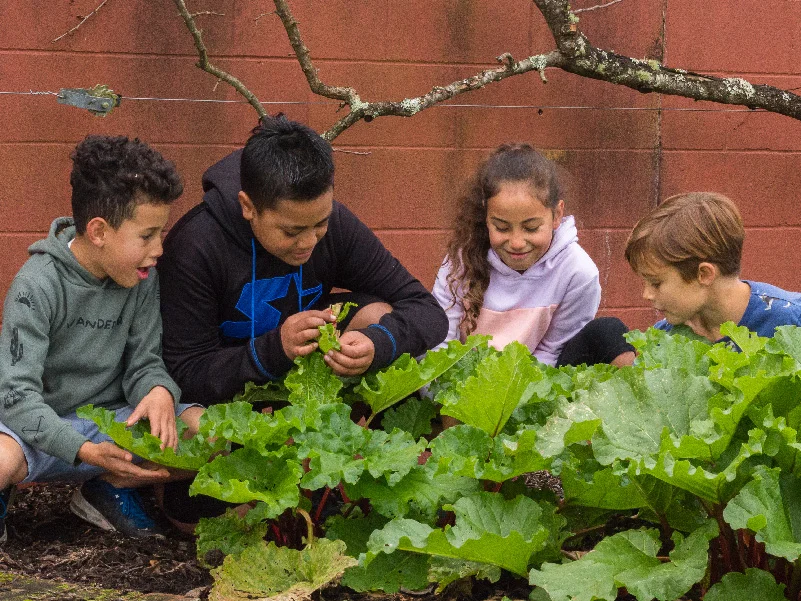
Broadly though, the kaupapa advocates for school outdoor spaces to transform from being made up of largely concrete and grass fields with mostly plastic playground equipment fixed permanently in place to be places that include a range of natural play spaces, trees, hillocks and gardens. Gardens could include productive gardens where children could learn how to grow, harvest and prepare healthy kai. The grounds should include quiet spaces where smaller groups of children or individuals can play and learn without feeling isolated or anxious. They should provide opportunities to manipulate and learn from natural materials such as water.
The grounds should also provide opportunities for riskier play to allow children the chance to test and understand their personal limits and to be physically active, building their resilience and motor skills. ‘Loose parts’, a concept borrowed from ECCE, should be provided such as tyres, driftwood, planks and hoses, to encourage collaborative and creative play and help children to build problem-solving and social skills.
The grounds should also be designed with clear references and connections the school’s rohe, referencing for example, bush, mountains, rivers and beaches. They should include references to aspects of Te Ao Māori such as traditional use plant species, Māori carvings, art and iconography. Priority in this space is connection to mana whenua first and foremost, with the ability for tamariki to then connect in their own individual whakapapa.